Abstract
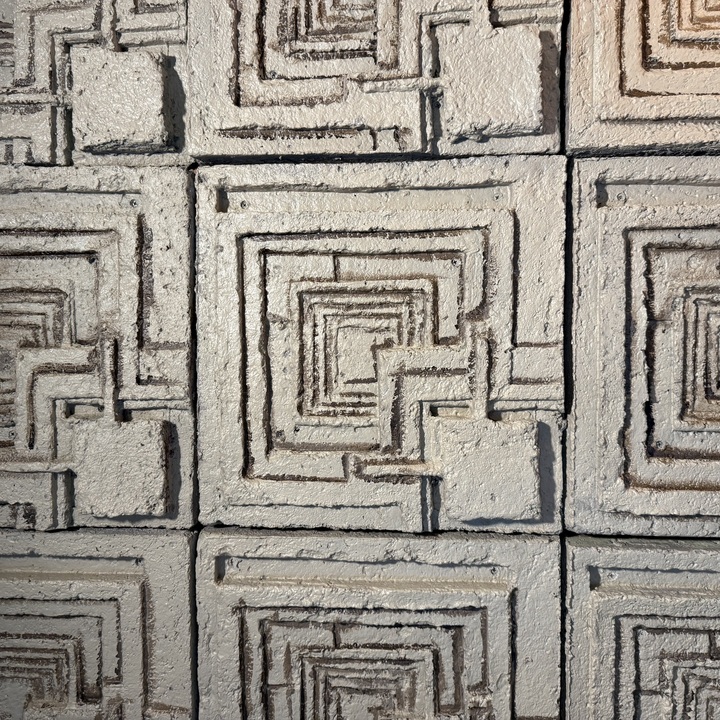
This was the first project I would consider including among this continuity. Fall of 2020, I became completely obsessed with the Frank Lloyd Wright textile block houses around Los Angeles. I was interested in fiction that focused on grief and ghosts around the time, and I had a life long interest in Wright’s architecture style. I realized this time around, paying attention to it that these Mayan style houses were completely concrete, following the murder and arson that killed Wright’s family, he was making for his clients homes that were designed against this isolated incident that had caused a permanent change to his style. These houses were evidence of that, with the Hollyhock house having a literal moat around the fireplace. The block style found in the Ennis house is the most commonly referenced and used motif from this period, found in the sets of Blade Runner, Twin Peaks, Mulholland Drive, yet its design isn’t reminiscent of anything in particular which is one of the things I really like about it.
Design
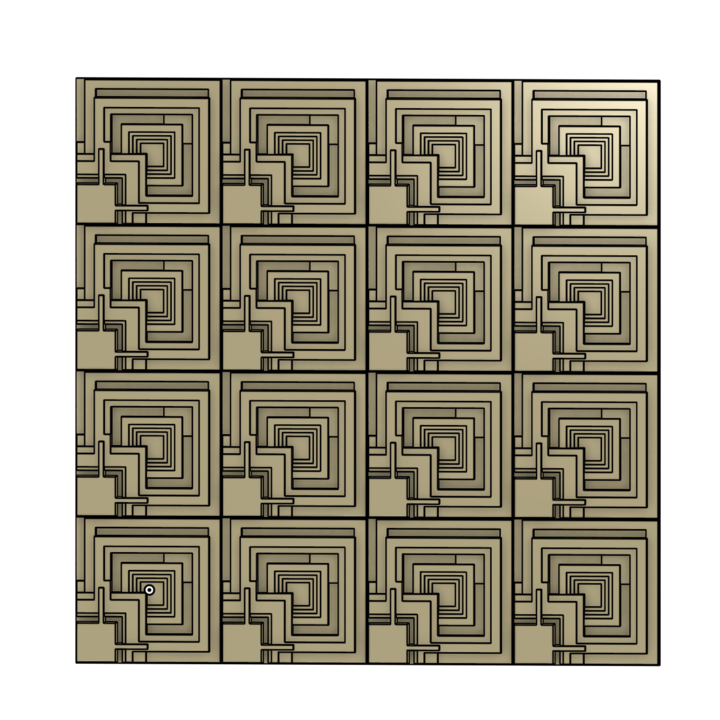
Getting the shape exactly right was a challenge, especially given the confusion between orientation of some elements in famous reproductions, like the Blade Runner style. There was another spooky moment when working on the layout of the blocks that resonated with me. It was hard to center the middle of the deepest square. I couldn’t find the exact xy dimensions of certain elements in the pattern and it led to all sorts of problems getting the final locations of sections correct. I looked at the design for so long and eventually realized that by changing the size of one section, it would have to proportionally change everything else just so that the final design was perfect after that one tweak. In that moment it felt like I was being told that I understood how the pieces of the design went together, and it freaked me out a bit.
Living in Los Angeles, I went to the Ennis house to measure details I couldn’t find online. I then made some basic elevation drawings of the various levels of the positive concrete molded block that were shared from one area to another. I proceeded from here directly to making foam facsimiles.
Fabrication
I started by using insulation foam laid out into stacked thin sheets that I carved according to a drawing on top that I copied over from my sketches. This first version was dimensionally incorrect and too weak to make a concrete block from. I tried to make a secondary mold using expanding foam but it glued itself to the insulation foam and ripped the whole thing apart. So I now had to start from scratch. Using the remnants of the destroyed mold for a sanity check, I began making a direct negative mold that I could create blocks from, using project board to cheaply make the 1/8th inch steps I thought were necessary for the elevation of the block, thought this was almost the worst possible material for the mold, it ended up working out pretty well. I made a frame of 1x3s around this basic 16x16” pattern and could make Ennis blocks easily.
This is the point where I started to discern between concrete and cement, and cement with or without mix ins. My eventual solution was to add cellulose house insulation to plastic cement to create a faux concrete texture while adding limited weight to the overall mix. These also had more structure and I could produce an extra block for each bag of cement with this procedure. My goal was to create 9 blocks, enough to tile the width of one wall of my room while leaving a row of blank blocks to better represent the way the textile blocks were used in the real houses, I repeated the process until I had 9 good ones, then weathering the blocks with dark paint in the corners for better contrast.
Conclusions
The final wall I built with these blocks remains incomplete, I would like to try again with a lighter weight solution for the cement casting, because the weight of the panel I made for my room scares me sometimes, my blocks also missed the mark on overall depth, the real blocks step closer to 3/8” or even more, so more detail and recessing is definitely possible in a second iteration.